
Industrial Roof Trusses: Understanding and Designing
Introduction to Industrial Roof Trusses
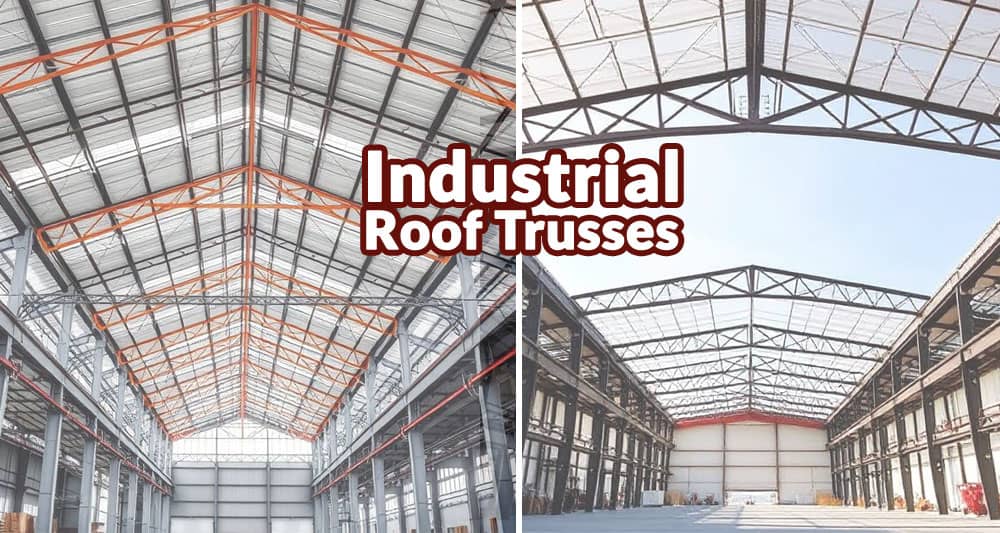
Industrial roof trusses play a vital role in supporting large structures, providing stability, and ensuring the integrity of industrial buildings. These structural frameworks are engineered to span wide areas while bearing significant loads. Understanding their design, materials, and types is essential for optimizing construction efficiency and durability.
Types of Industrial Roof Trusses
1. Pratt Truss
The Pratt truss is one of the most common types used in industrial settings. It features vertical and diagonal members that efficiently handle tensile and compressive forces. The diagonal members are subjected to tension, while the vertical ones bear compression, making this design ideal for long spans.
2. Warren Truss
The Warren truss consists of equilateral triangles that distribute loads evenly. This truss type minimizes material usage while maximizing strength, making it a cost-effective choice for warehouses and manufacturing plants.
3. Howe Truss
Unlike the Pratt truss, the Howe truss has diagonal members that bear compression, while the vertical members handle tension. This configuration makes it suitable for supporting heavy roofing materials in industrial buildings.
4. Fink Truss
The Fink truss is commonly used in roofs with steep pitches. Its multiple diagonal members create a web-like structure, offering superior load distribution and increased rigidity.
5. Scissor Truss
For industrial buildings requiring vaulted ceilings, the scissor truss provides an excellent solution. It features crossing web members that allow for an open and spacious interior while maintaining structural integrity.
Key Materials Used in Industrial Roof Trusses
1. Steel Trusses
Steel trusses are preferred in industrial applications due to their high strength-to-weight ratio, resistance to environmental factors, and ability to support large spans. They are particularly useful in factories, warehouses, and production facilities.
2. Timber Trusses
While not as common in heavy industry, timber trusses are still used in certain industrial settings where cost and sustainability are priorities. They offer excellent insulation properties but require treatment to resist pests and moisture.
3. Aluminum Trusses
Aluminum trusses provide a lightweight yet strong alternative to steel. They are resistant to corrosion, making them ideal for industries operating in coastal or humid environments.
Design Considerations for Industrial Roof Trusses
1. Load-Bearing Capacity
The load-bearing capacity of a truss is determined by factors such as span length, material strength, and expected environmental conditions. Engineers must calculate dead loads (permanent structures) and live loads (variable weights like snow and wind).
2. Spanning Capabilities
Industrial buildings often require wide-span trusses to minimize the need for interior columns. The design must ensure structural stability without excessive material usage.
3. Environmental Factors
Wind, snow, seismic activity, and temperature fluctuations must be considered when designing roof trusses to ensure they withstand natural forces without compromising safety.
4. Connection Methods
Bolted, welded, or gusset plate connections affect the overall stability and longevity of a truss. The chosen method depends on the material and expected load conditions.
5. Cost and Efficiency
Optimizing material use while ensuring durability is crucial for cost-effective construction. Engineers must balance affordability and structural integrity to achieve the best results.
Installation Process for Industrial Roof Trusses
1. Site Preparation
Before installation, the construction site must be inspected for stability. Proper foundations must be in place to support the weight of the roof trusses.
2. Truss Assembly
Trusses can be pre-assembled off-site and transported for installation or built on-site depending on logistical and cost considerations.
3. Lifting and Placement
Cranes and other lifting equipment are used to position the trusses onto support beams. Precision is crucial to align the trusses correctly before securing them in place.
4. Fastening and Reinforcement
Once positioned, trusses are securely fastened using bolts, welding, or gusset plates. Additional bracing may be required for added strength.
5. Final Inspection
A thorough inspection ensures that all connections are secure, alignment is correct, and the trusses meet safety regulations before proceeding with roof installation.
Benefits of Industrial Roof Trusses
1. Cost-Effectiveness
By optimizing material usage and minimizing the need for interior support columns, roof trusses reduce overall construction costs.
2. Structural Integrity
Designed to handle significant loads, trusses ensure long-term stability and durability, reducing maintenance costs over time.
3. Versatility
Available in various designs, trusses can accommodate different industrial requirements, from large manufacturing plants to warehouses and storage facilities.
4. Efficient Load Distribution
Trusses distribute weight evenly, preventing localized stress points that could compromise the structure's integrity.
5. Faster Construction
Prefabricated trusses allow for quicker installation, reducing project timelines and labor costs.
Conclusion
Industrial roof trusses are an essential component of modern construction, providing cost-effective, strong, and versatile solutions for large-scale buildings. Understanding the different types, materials, and design considerations helps in selecting the right truss system for specific industrial applications.