
Standard Staircase Dimensions in Buildings - Complete Professional Guide
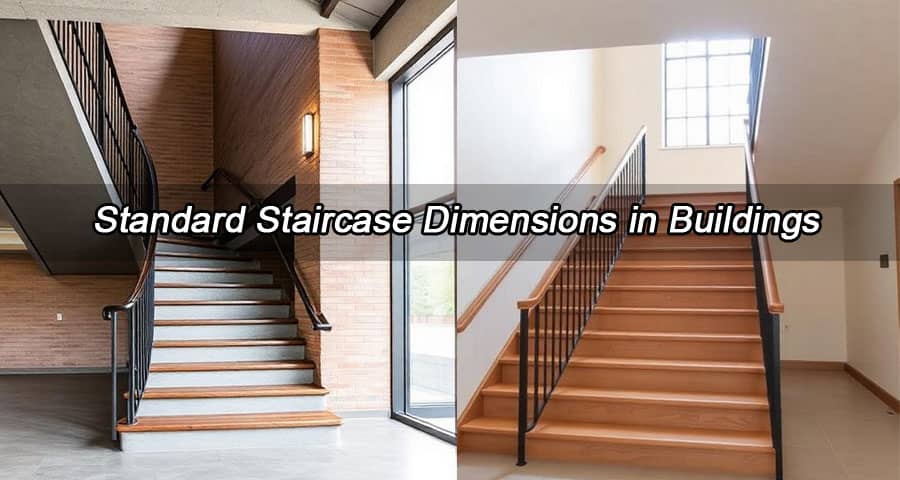
Designing a staircase is not merely a structural requirement; it is a functional, safety-driven, ergonomic, and aesthetic necessity in any residential, commercial, or industrial building. We ensure that every staircase complies with standard staircase dimensions, delivers optimal comfort, and enhances long-term usability.
Understanding Staircase Fundamentals
A staircase is a structured arrangement of steps allowing vertical movement between floors. Each staircase comprises several essential components:
- Tread - Horizontal surface where the foot rests
- Riser - Vertical face between two treads
- Nosing - Projecting edge of the tread
- Flight - Continuous series of steps without a landing
- Landing - Horizontal platform separating flights
- Handrail - Safety support rail
- Balustrade - Protective barrier along edges
- Headroom - Vertical clearance above steps
Accurate proportions ensure safe climbing, reduced fatigue, improved accessibility, and regulatory compliance.
Standard Staircase Width Dimensions
The width of a staircase determines comfort, evacuation efficiency, and usability.
Recommended Staircase Width Standards
- Residential Buildings:
- Minimum clear width: 900 mm (36 inches)
- Ideal comfort width: 1000 - 1100 mm
- Commercial Buildings:
- Minimum clear width: 1200 mm (48 inches)
- High-occupancy buildings: 1500 mm or more
- Public and Institutional Buildings:
- Minimum: 1500 - 2000 mm for crowd movement
Wider staircases improve bidirectional traffic flow, emergency evacuation efficiency, and furniture movement.
Standard Riser Height Dimensions
The riser height defines how steep or gentle the staircase feels.
Ideal Riser Height Ranges
- Residential:
- Standard riser: 150 - 190 mm (6 - 7.5 inches)
- Optimal comfort: 165 - 175 mm
- Commercial and Public:
- Standard riser: 130 - 170 mm (5 - 6.7 inches)
- Lower risers improve safety for elderly and high traffic zones
Uniform riser heights prevent tripping hazards and walking rhythm disruption.
Standard Tread Depth Dimensions
Tread depth determines foot stability and walking comfort.
Recommended Tread Sizes
- Minimum tread depth: 250 mm (10 inches)
- Comfortable tread depth: 270 - 300 mm (10.5 - 12 inches)
- Public buildings: Often exceed 300 mm
Deeper treads reduce foot overhang, slipping risk, and fatigue during prolonged usage.
Riser - Tread Proportion Formula
To achieve ergonomic comfort, the classic proportion formula applies:
2R + T = 600 - 650 mm
Where:
- R = Riser height
- T = Tread depth
Example:
If riser = 170 mm
Then tread ≈ 260 - 310 mm
This balance ensures natural walking rhythm and reduced strain.
Standard Staircase Slope and Angle
The angle of inclination affects climbability and safety.
Acceptable Staircase Angles
- Ideal angle: 30° - 35°
- Maximum permissible: 38°
- Gentle staircases: 25° - 30° (hospitals, schools)
Steeper angles increase fall risk and physical strain, while gentle slopes enhance accessibility.
Standard Headroom Clearance
Headroom prevents collisions and improves visual comfort.
Minimum Headroom Requirements
- Residential: 2100 mm (7 feet)
- Commercial/Public: 2200 - 2300 mm
Measured vertically from the tread nosing to the overhead structure, sufficient headroom ensures unrestricted movement and safety compliance.
Standard Landing Dimensions
Landings allow rest, direction change, and safety transition.
Landing Size Guidelines
- Minimum landing width: Equal to stair width
- Minimum landing length: 900 - 1200 mm
- After every 12 - 14 risers: Mandatory landing recommended
- Door swing clearance: Additional space required
Proper landings enhance user comfort and emergency maneuverability.
Standard Handrail Height and Graspability
Handrails are critical for balance and safety.
Handrail Height Standards
- Residential: 850 - 900 mm (34 - 36 inches)
- Commercial/Public: 900 - 1000 mm (36 - 40 inches)
- Child-access areas: Secondary rail at 600 - 700 mm
Handrail Grip Diameter
- Ideal grip diameter: 38 - 50 mm
- Continuous, smooth, and non-slip finish recommended
Handrails must support continuous grip without obstruction.
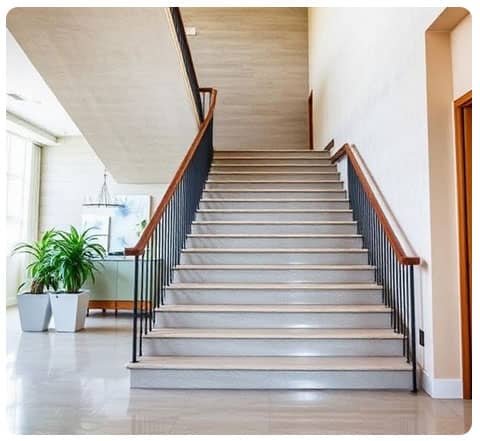
Balustrade and Guardrail Safety Dimensions
Balustrades prevent falls from elevated edges.
Guardrail Height
- Minimum height: 1050 mm (42 inches)
Spacing Between Balusters
- Maximum clear gap: 100 mm (4 inches) to prevent child entrapment
Proper spacing ensures child safety and regulatory compliance.
Nosing Projection Standards
Nosing enhances visibility and foot placement.
Recommended Nosing Dimensions
- Projection: 20 - 30 mm
- Rounded edge radius: 6 - 12 mm
- Anti-slip strips: Highly recommended
Well-designed nosing improves traction and step visibility.
Staircase Lighting Standards
Lighting significantly impacts safety and usability.
Illumination Recommendations
- Minimum illumination: 100 - 150 lux
- Uniform lighting without shadows
- Emergency backup lighting mandatory in public buildings
- Motion sensors enhance energy efficiency
Proper lighting reduces missteps and night-time accidents.
Accessibility and Universal Design Considerations
Modern buildings prioritize inclusive accessibility.
Key Accessibility Features
- Lower riser heights: 130 - 150 mm
- Wider treads: 300 mm+
- Non-slip surfaces
- High-contrast step edges
- Continuous handrails both sides
- Intermediate resting landings
Accessible staircases promote universal usability and regulatory compliance.
Fire Safety and Egress Staircase Dimensions
Emergency staircases must support rapid evacuation.
Fire Staircase Standards
- Minimum width: 1200 - 1500 mm
- Fire-rated enclosure walls
- Non-combustible finishes
- Photoluminescent step markings
- Direct exit access
Egress staircases must remain unobstructed, illuminated, and clearly marked.
Material Impact on Staircase Dimensions
Different materials influence dimensional accuracy and durability.
Common Materials
- Concrete: High durability, precise dimension stability
- Steel: Slim profiles, industrial aesthetics
- Wood: Warm aesthetics, requires moisture control
- Glass: Visual openness, requires laminated safety glass
- Stone: Premium finish, high load capacity
Material selection affects tread thickness, slip resistance, maintenance, and lifespan.
Standard Staircase Dimension Reference Table
| Element | Standard Range |
| Stair Width | 900 - 1500 mm |
| Riser Height | 150 - 190 mm |
| Tread Depth | 250 - 300 mm |
| Stair Angle | 30° - 35° |
| Headroom | ≥ 2100 mm |
| Handrail Height | 850 - 1000 mm |
| Landing Length | =900 mm |
| Guardrail Height | ≥ 1050 mm |
| Nosing Projection | 20 - 30 mm |
This table supports quick planning and verification.
Best Practices for Long-Term Staircase Performance
- Maintain uniform riser heights throughout the flight
- Ensure anti-slip finishes on treads and nosing
- Provide adequate lighting coverage
- Use durable handrail materials
- Keep stairways free from obstructions
- Perform periodic structural inspections
Consistent maintenance preserves safety, aesthetics, and lifespan.
Conclusion - Precision in Staircase Dimensions Ensures Safety and Value
Accurate implementation of standard staircase dimensions in buildings ensures optimal safety, usability, regulatory compliance, and architectural harmony. By aligning riser heights, tread depths, widths, handrail placement, lighting, and headroom with proven standards, we deliver staircases that function efficiently for decades. Precision planning reduces construction errors, enhances occupant comfort, and maximizes structural reliability across residential, commercial, and institutional projects.